Reflections from CHI 2026
By Kimberley Paradis
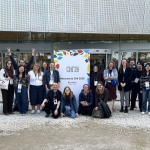
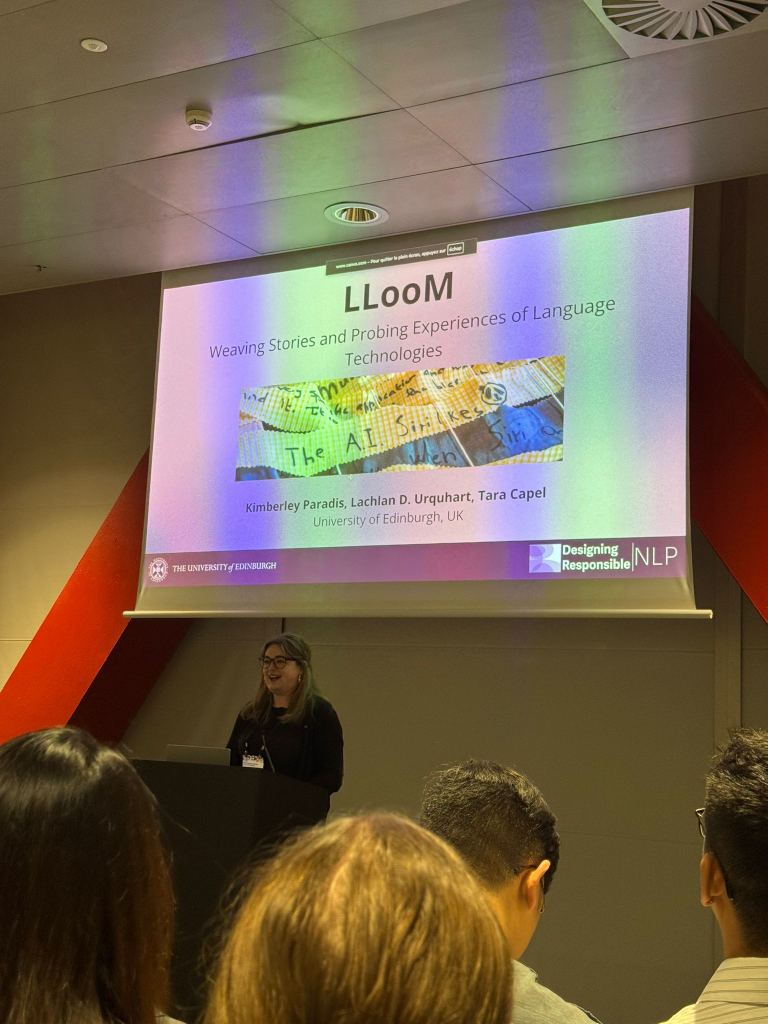
In April 2026, I attended my first CHI in Barcelona, Spain to present my paper “LLooM: Weaving Stories and Probing Language Technologies.” Through weaving and storytelling, it explores how people make sense of language technologies.
It was a very thought-provoking conference. There were several stand-out papers and events.
Queering AI-Generated Histories
One highlight was watching Alexandra Teixeira Riggs present “Reconfiguring through Ruptures: Material Reconfigurations and Un/Making as Tangible Tactics for Queering AI-Generated Histories.”
This paper presents an autoethnographic study of AI-generated images of Queer histories. The lead author generated images based on their own memories of Queer historical places and events, printed them as photographs, and then un/made them through hand-drawn annotations and material processes such as submerging, lubing, scratching, and burying. These reconfigured works materialise the ruptures of Queer erasure and misrepresentation.
I really enjoyed reading about how the authors navigated the tension between non-use of generative AI systems and material unmaking. The paper is beautifully written and includes amazing images of the work.
Designing for Disconnection
I also enjoyed Reese Muntean’s presentation of “A Dot on the Map: Co-Designing for Technological and Social Disconnection on an Arctic Expedition.”
The project involved a co-design workshop on a ship in remote areas of the Arctic with limited connectivity. The paper explores people’s needs, behaviours, and social dynamics under conditions of digital disconnection. It also asks what these experiences can teach us about designing better tools for connection in everyday life.
The paper raises a paradox that is particularly interesting. Participants wanted ways to share that were lightweight and unobtrusive “without taking them out of the moment”, but they also valued slow, intentional, analogue forms of connection “even though [these] would require more dedicated time and intentionality”. The paper and presentation were really strong provocations for reflecting on what it means to design for dis/connection, especially when people want to connect with remote friends and family without shifting their attention entirely to the technology or to the act of communicating.
Rethinking Compensation in HCI
Another standout paper was “I Participate, Therefore We Benefit: Ubuntu as a Relational Compass for Ethical Compensation in HCI,” presented by Jaydon Farao.
Drawing on the southern African philosophy of Ubuntu, the paper uses a decolonial lens to critique how HCI approaches participation and compensation. They discuss the “research gig economy” where research participation becomes a source of income for community members.
This can make participation resemble gig work where people are paid for tasks, but the relationship is not a sustained or reciprocal partnership. If a researcher cancels a workshop, this can affect the livelihood of a community member who was relying on that compensation.
I really appreciated the paper’s call for compensatory statements in HCI. These would require authors to explain how compensation was determined, who was involved in that decision, and how the project benefits the community beyond publication. This paper is a “must-read” for anyone working with participants.
Stitch ’n B*tch
I also attended CHI Stitch ’n B*tch: A Feminist HCI Meetup, which was wonderfully organised by Nadia Campo Woytuk, Nimra Ahmed, Mafalda Gamboa, Fiona Bell, Benedetta Lusi, Daisy O’Neill, Michael Muller, Xinglin Sun, Amelia Lee Dogan, Adrian Petterson, Ana O Henriques, Gisela Reyes-Cruz, Anupriya Tuli, and Angelika Strohmayer.
The event was so well attended that people filled both the room and part of the outdoor deck. It was a thoughtful space for feminist HCI researchers to craft, talk, and connect. You can find out more about the Feminist HCI community here: https://feminist-hci.github.io/.
CHI 2026 gave me a lot to think about! It was amazing to attend so many presentations and events, and to connect with people working across Queer, feminist, material, and decolonial approaches to HCI and research.