Holding MenstaRay
PhD project
PhD student:
Supervisors:
Bettina Nissen (Design Informatics)
Outputs from this project
We developed the design prototype from three main aspects:
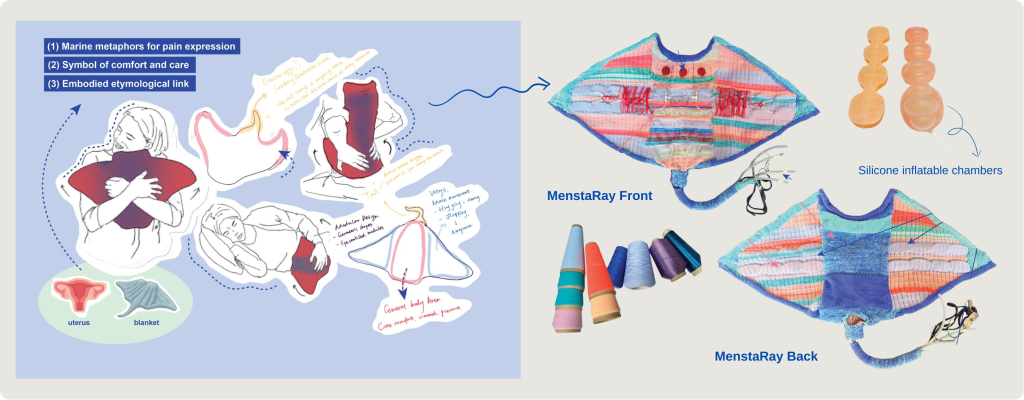
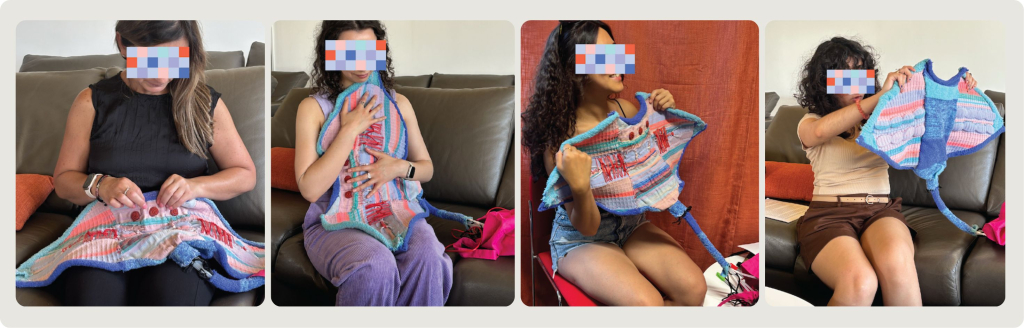
– Design conceptualisation: (1) participants frequently used marine creatures as metaphors to express the ambivalent qualities of pain, such as a jellyfish (beautiful yet invasive). Similarly, the manta ray possesses an elegant aesthetic with dynamic, organic movements, aptly reflecting the fluid and changing nature of menstrual pain; (2) etymologically speaking, the term manta means blanket in Spanish and Portuguese, aligning with the high frequency with which participants referenced blankets as symbols of self-care; (3) the overall shape of a manta ray resembles a uterus, closely connecting to the research topic.
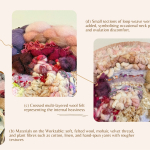
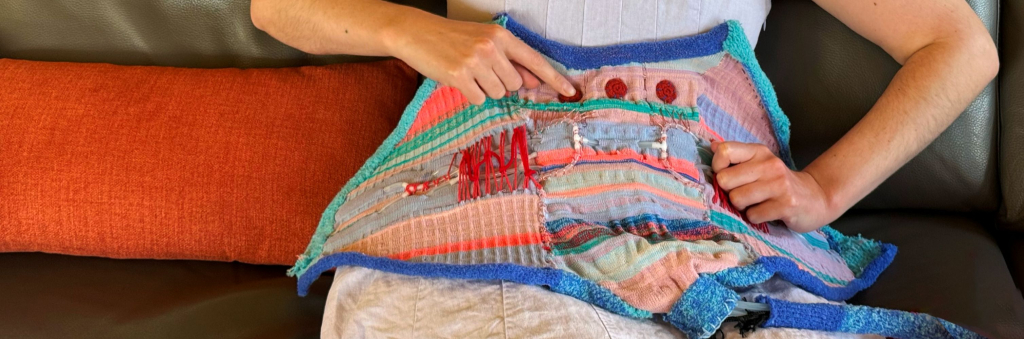
– Appearance: Based on participants’ mixed feelings toward menstruation, this prototype uses a two-sided design to reflect the complexity of menstrual pain (Fig. 2). The outward-facing side features varying shades and thicknesses of red yarn to represent fluctuations in pain intensity, alongside rough metallic wire to convey bodily discomfort. Conversely, the inward-facing side (blue) symbolises a personal space for emotional recognition and self-care.
– Interaction: Drawing on participants’ descriptions of pain rhythms, it interacts dynamically with the menstruating body in three ways (Fig. 3): (1) the MenstaRay’s “fins” gradually intensifying from gentle waves to sudden peaks, followed by a slow easing; (2) lingering yet irregular sensations; and (3) a self-care mode, in which the “fins” slowly fold inward around the abdomen, providing a comforting, hug-like sensation.
Collaborators:
Mingke Wang: Dyson School of Design Engineering, Imperial College London, London, United Kingdom
Imogen A Young: Dyson School of Design Engineering, Imperial College London, London, United Kingdom
Rebecca Stewart: Dyson School of Design Engineering, Imperial College London, London, United Kingdom
Funder: SGSAH Collaborative Doctoral Award
Project dates: 2025 – 2026